Hyper scooter
WEPED Sonic X
CNC-cut aluminium, 120 km/h (130 unlocked), SUPER LAUNCH and rainbow RGB — the fastest scooter with full tuning.
- Top speed in game
- 120km/h
- 0–50 km/h
- 3.43s
- Battery
- 4,200Wh
- Price
- $32,000
DYNO flat out 119.7 km/h
Stock, DYNO
84 V 50 Ah
In-game money

Overview
The WEPED Sonic X is the top of the Scooter Hub line-up. Its frame is bare CNC-cut aluminium plates; in the game it reaches 120 km/h stock, 130 km/h with a paid unlock and about 165 km/h with full tuning, and it is the only scooter with SUPER LAUNCH.
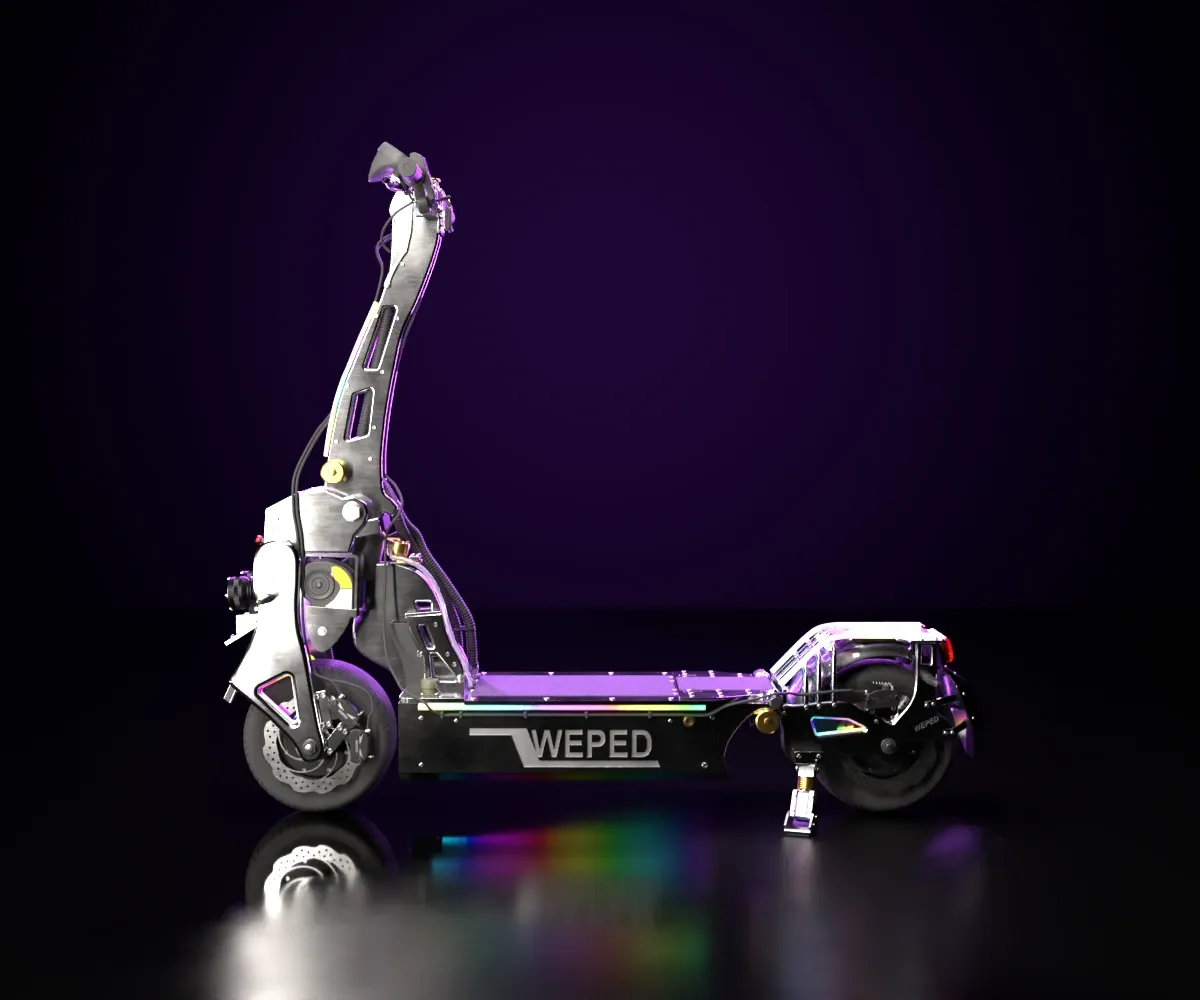
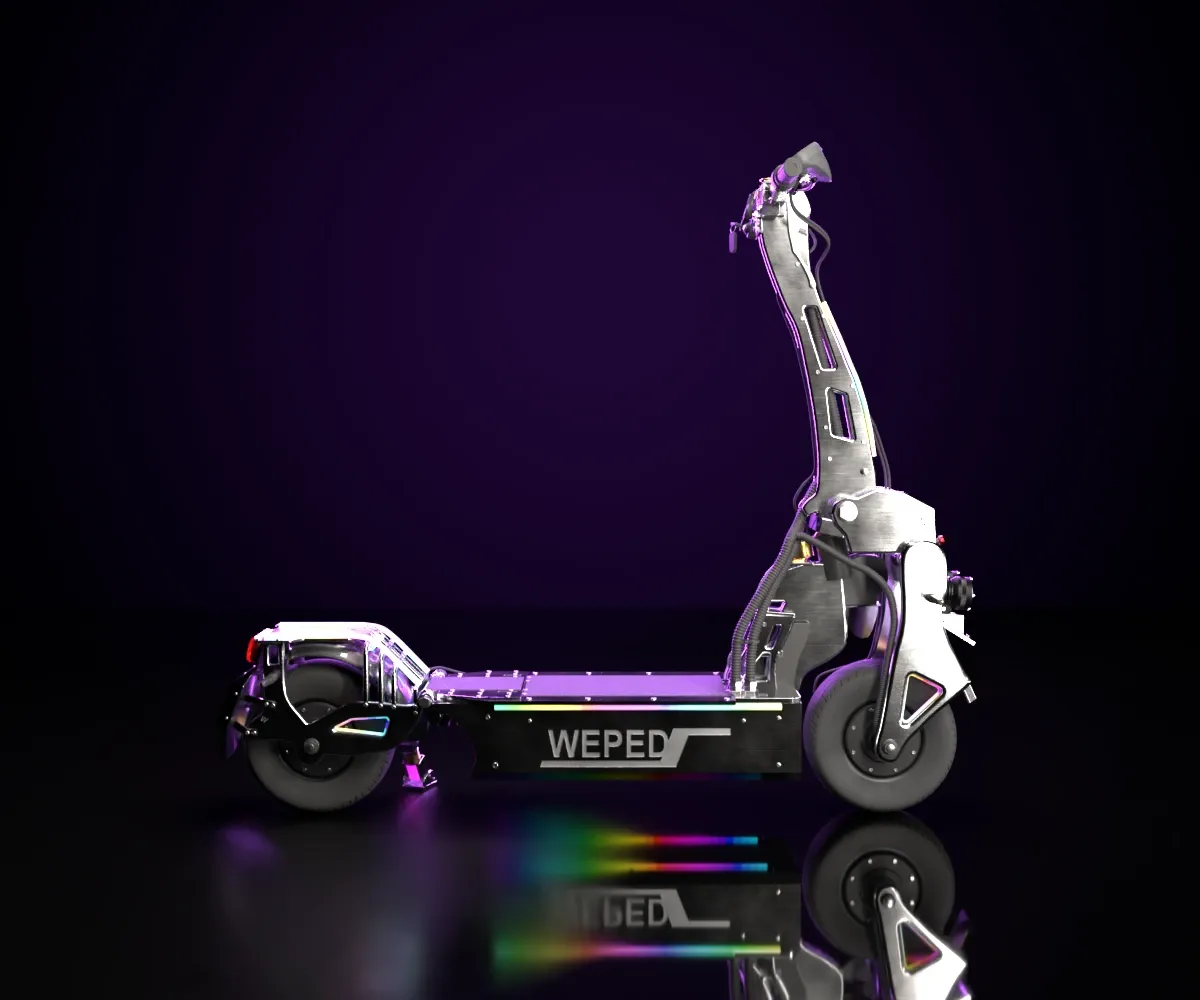
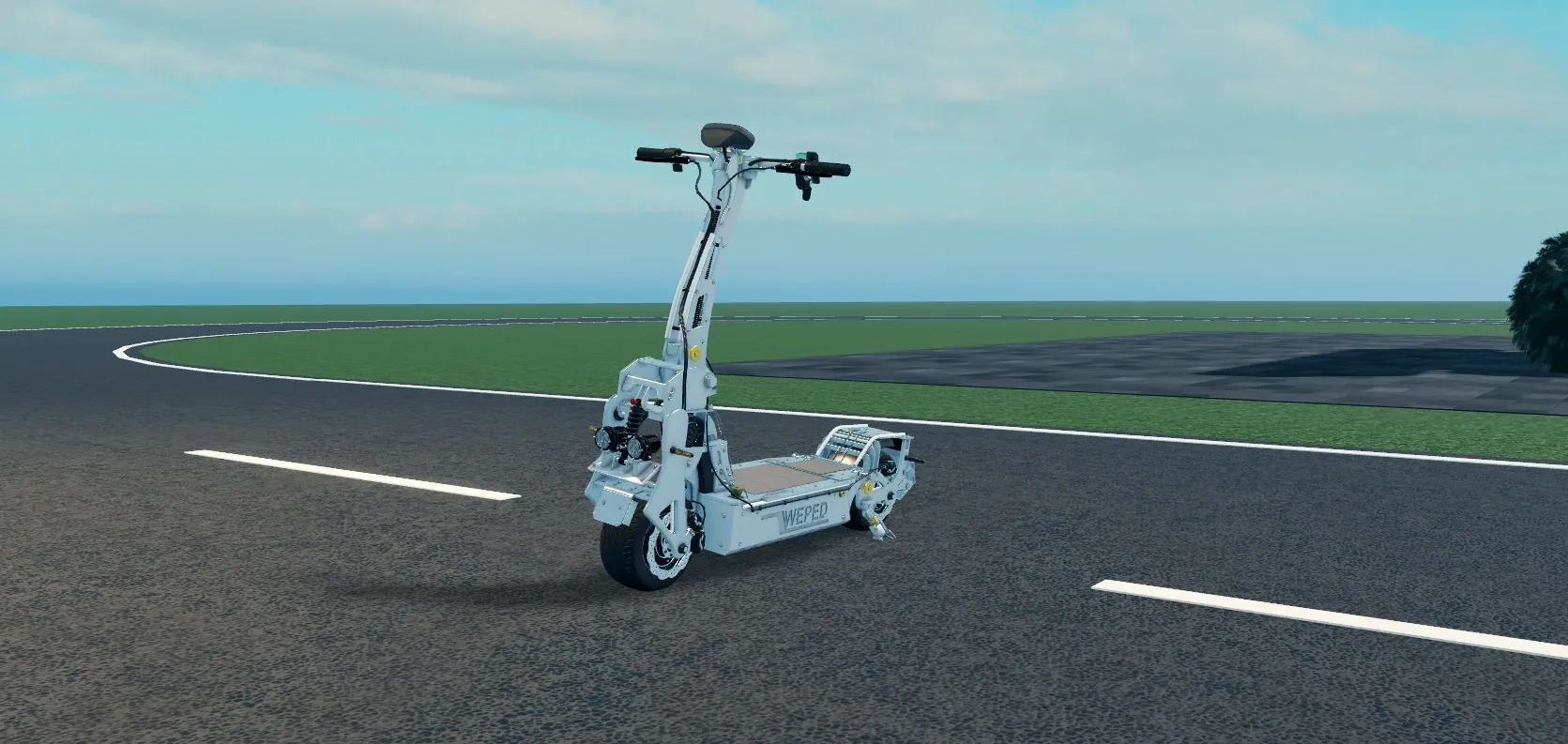
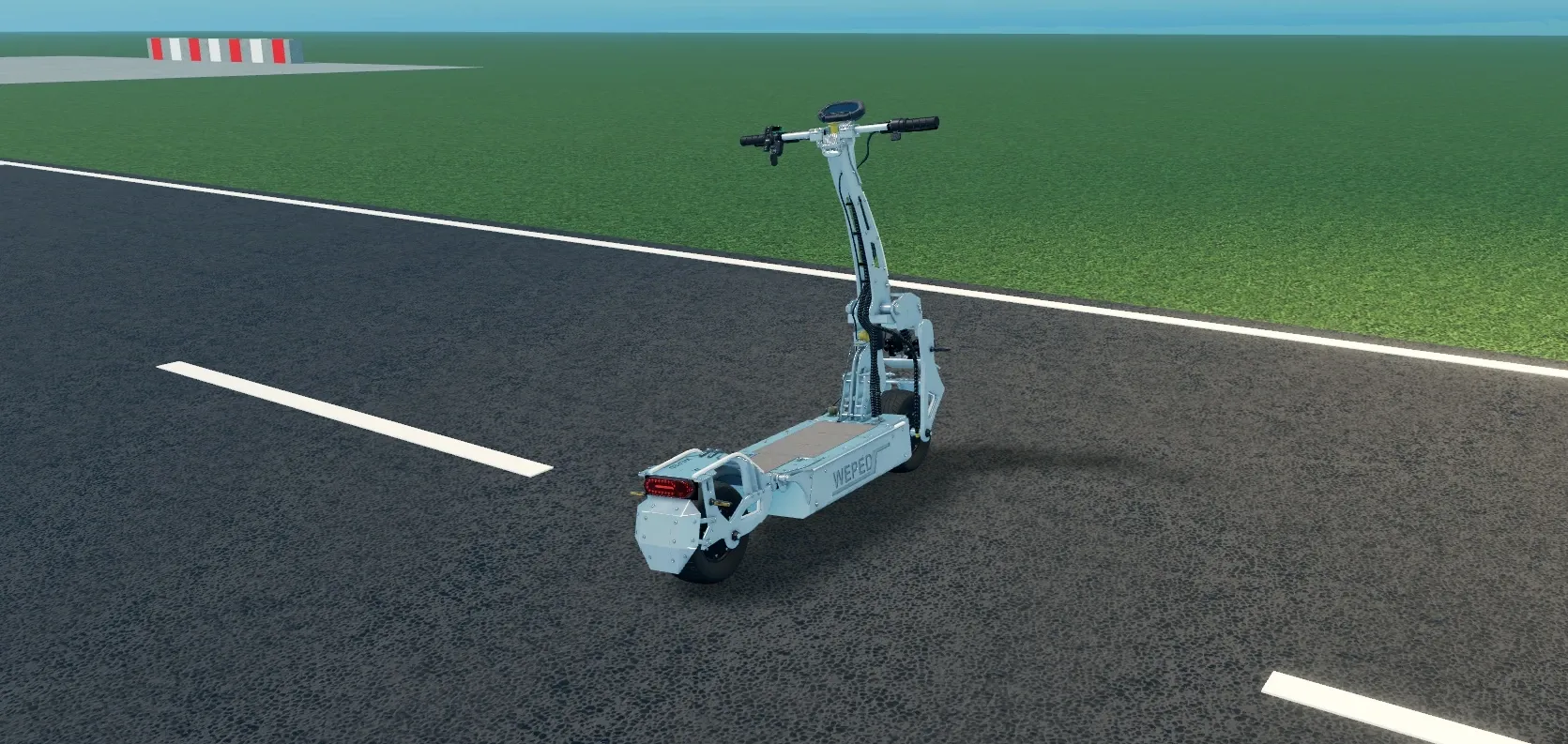
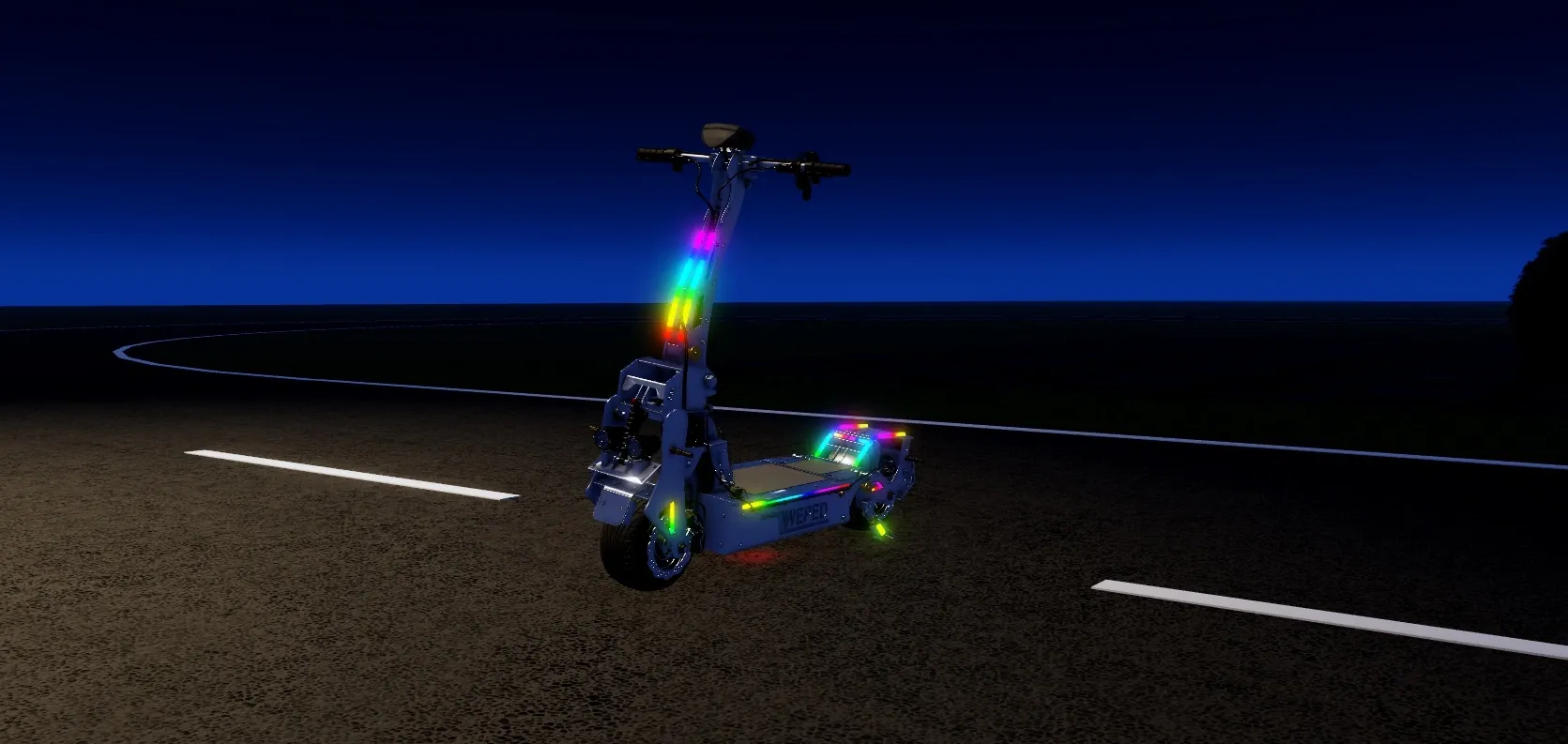
The WEPED Sonic X is the flagship of Scooter Hub. The real scooter is built from bare CNC-machined aluminium plates — no plastic covers — and the game model keeps that look: a grey, mirror-like metal frame with the WEPED lettering cut into it, a cage-like rear end with clear acrylic spines, and RGB light strips in almost every window of the frame.
It is the fastest scooter in the game. Stock it is limited to 120 km/h, the maker’s marketed limit; the SONIC X 130 KM/H UNLOCK ($4,000) opens the 130 km/h the maker quotes flat out, and with full tuning the DYNO shows about 165 km/h. It is also the only scooter with SUPER LAUNCH, a held-brake burnout start that takes half a second off 0–60 km/h.
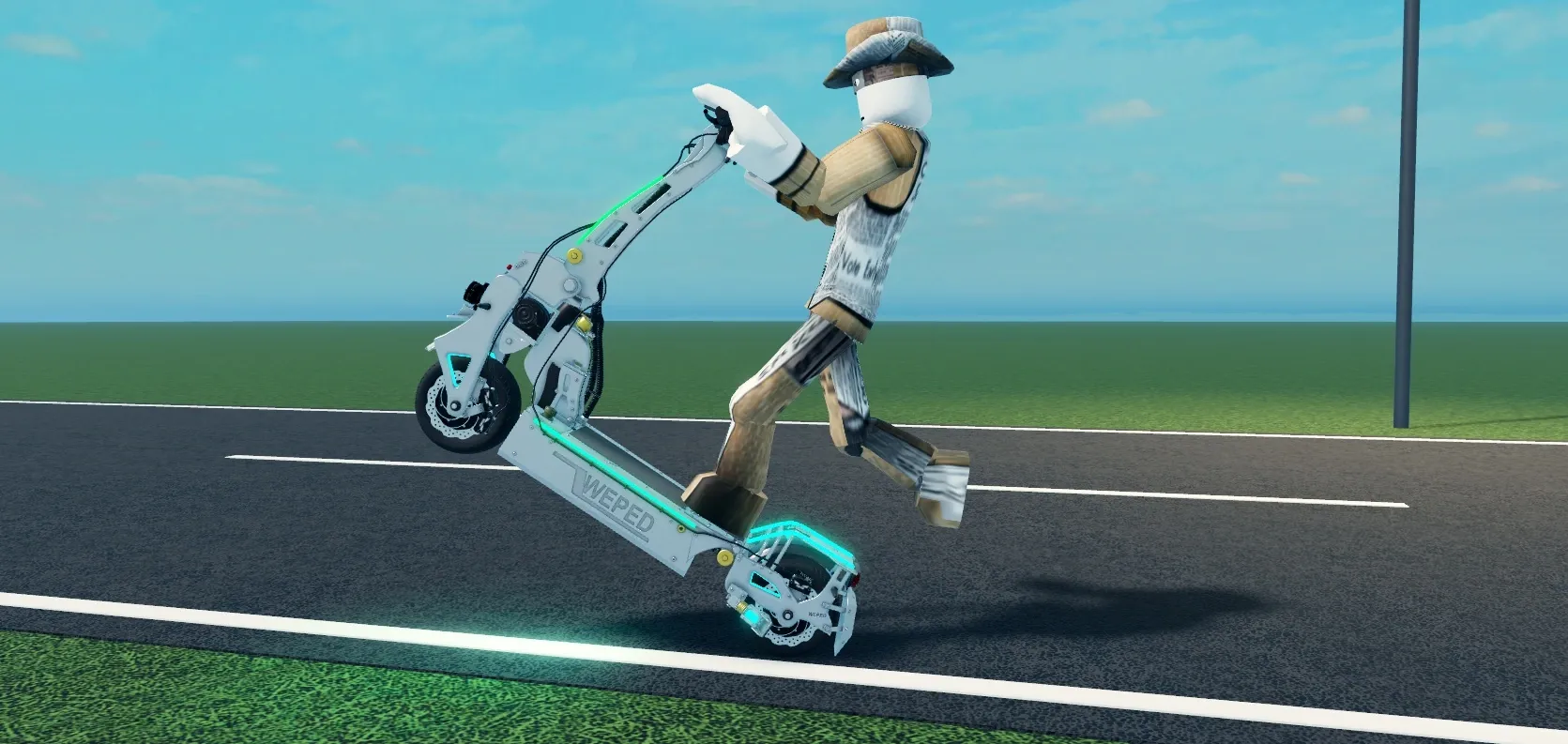
At 79.5 kg it is a heavy scooter, and the simulation treats it that way: the front only lifts at about 0.63 g on the rear wheel alone, so a wheelie needs a half-jump first.
In Scooter Hub the WEPED Sonic X has 3 riding modes (ECO: 45 · NRM: 80 · SPT: 120 km/h). It weighs 79.5 kg, carries a 84 V 50 Ah battery (4,200 Wh) and has two 2,000 W hub motors. A hydraulic steering damper calms the bars at speed. It is heavy enough that a wheelie needs a half-jump first.
Real scooter vs in-game
What the manufacturer publishes next to the numbers the simulation actually uses. Tags show where each game number comes from: C manufacturer figure, M measured on the 3D model, E simulation estimate where no factory figure exists. How we source numbers.
| Specification | Real WEPED Sonic X | In Scooter Hub |
|---|---|---|
| Top speed | Advertised 115–130 km/h flat out; marketed limit 120 km/h. | Modes ECO: 45 · NRM: 80 · SPT: 120 km/h E (Sim estimate) DYNO flat out: 119.7 km/h SONIC X 130 KM/H UNLOCK: $4,000 |
| Motors | Two BLDC hub motors, "4 kW" together (2,000 W each). | 2 × 2,000 W rated C (Manufacturer) Simulated peak 8,800 W and 75 N·m per motor |
| Battery | 84 V 50 Ah (4,200 Wh), Samsung 50E cells. | 84 V 50 Ah · 4,200 Wh C (Manufacturer) 20 cells in series in the voltage model |
| Weight | 79.5 kg; about 1.43 m nose to tail lamp (about 1.52 m with the rear mudflap). | 79.5 kg C (Manufacturer) Max load 150 kg; the rider adds 75 kg in the physics |
| Brakes | Hydraulic 4-piston calipers front and rear, two calipers on the front rotor; 200 mm wavy rotors. | 200 mm discs M (Measured) Both levers up to 6.6 m/s² on dry asphalt, 62 % on the front; rear alone 5.2 m/s² |
| Suspension | One oil shock in front, two at the rear. | Front 60 mm travel, 2.8 Hz Rear 60 mm travel, 2.7 Hz Spring-damper per wheel with bump stops |
| Tyres | 13-inch tubeless, 45 psi. | 13" C (Manufacturer), radius 0.15 m M (Measured) |
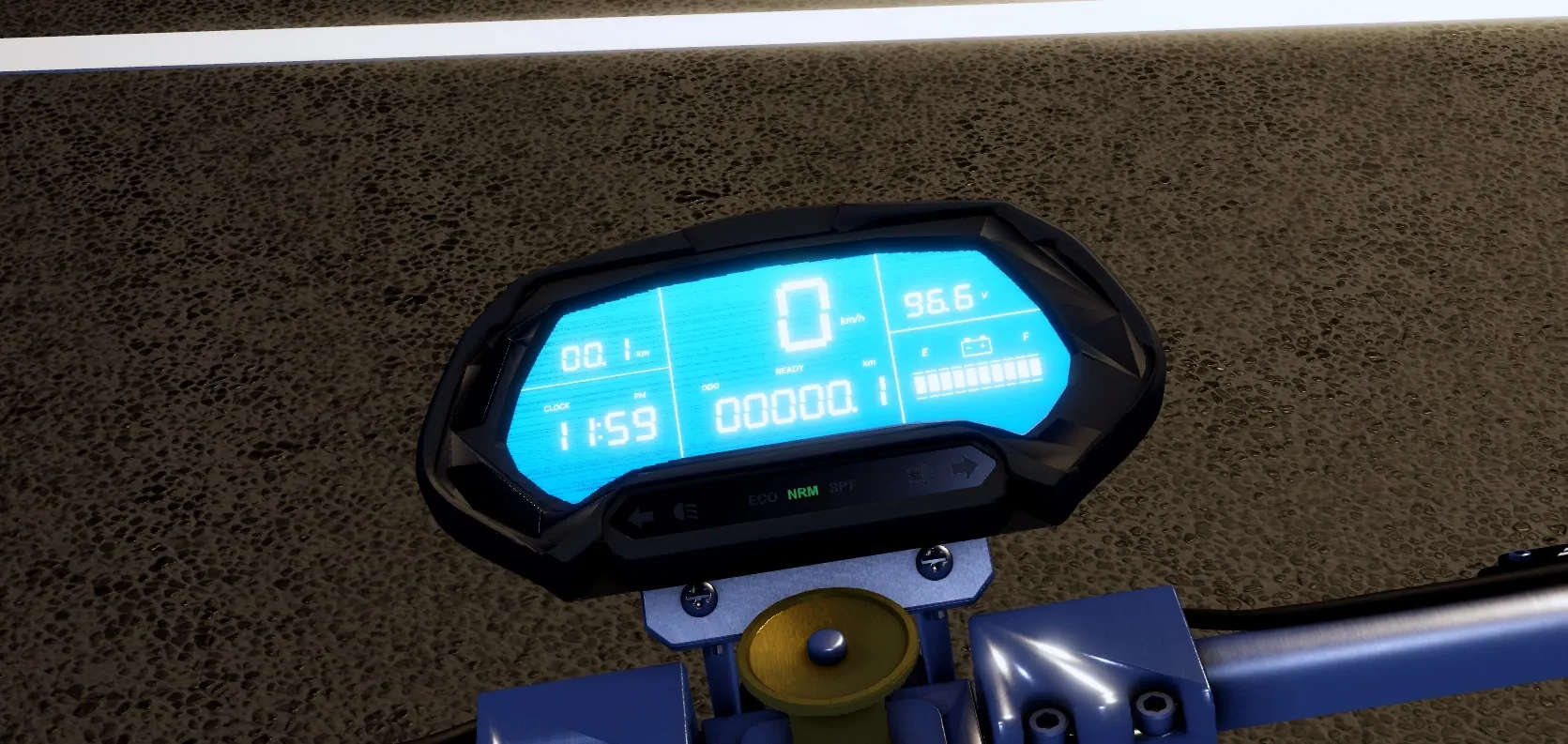
| Display | CT-22 LCD with ECO / NRM / SPT modes and a voltmeter in the key box. | CT-22 LCD (144 × 54 mm face, recessed in an 8 mm deep funnel) |
| Geometry | — | Wheelbase 1.115 m M (Measured), steering axis 12° M (Measured), lock ±32°, steering damper |
Performance in the game
Measured with the game's own DYNO model (the same physics the scooter rides with): flat dry asphalt, 75 kg rider, full battery, top mode, both motors. "Sustained" is the speed after five minutes at full throttle, when motor heat limits power. Range is at a steady 50 km/h (or the scooter's top speed if lower).
| Setup | Top | Sustained | 0–50 | 0–100 | Range |
|---|---|---|---|---|---|
| StockFactory scooter, no parts | 119.7 km/h | 119.7 km/h | 3.43 s | 7.41 s | 125 km |
| STREET packageController, better cells, semi-slick tyres | 119.8 km/h | 119.8 km/h | 3.33 s | 7.03 s | 186 km |
| RANGE packageLargest pack that fits + a bag battery | 119.7 km/h | 119.7 km/h | 3.36 s | 7.32 s | 215 km |
| RACE packageVESC controller, race cells, speed-wound motor, slicks, lowered | 165 km/h | 165 km/h | 3.21 s | 6.75 s | 191 km |
| OFF-ROAD packageOff-road tyres, torque-wound motor, lifted | 116.7 km/h | 116.7 km/h | 3.58 s | 7.76 s | 117 km |
| RAIN packageRain tyres and wet-weather pads | 119.7 km/h | 119.7 km/h | 3.42 s | 7.38 s | 123 km |
SUPER LAUNCH (this scooter only): 0–60 km/h in 3.3 s and 0–100 km/h in 6.6 s, against 3.8 s and 7.1 s on a normal start — measured in the game.
Riding modes
| Mode | Top speed | Torque | Power |
|---|---|---|---|
| ECOStarts in this mode | 45 km/h | 45 % | 30 % |
| NRM | 80 km/h | 75 % | 65 % |
| SPT | 120 km/h | 100 % | 100 % |
Display
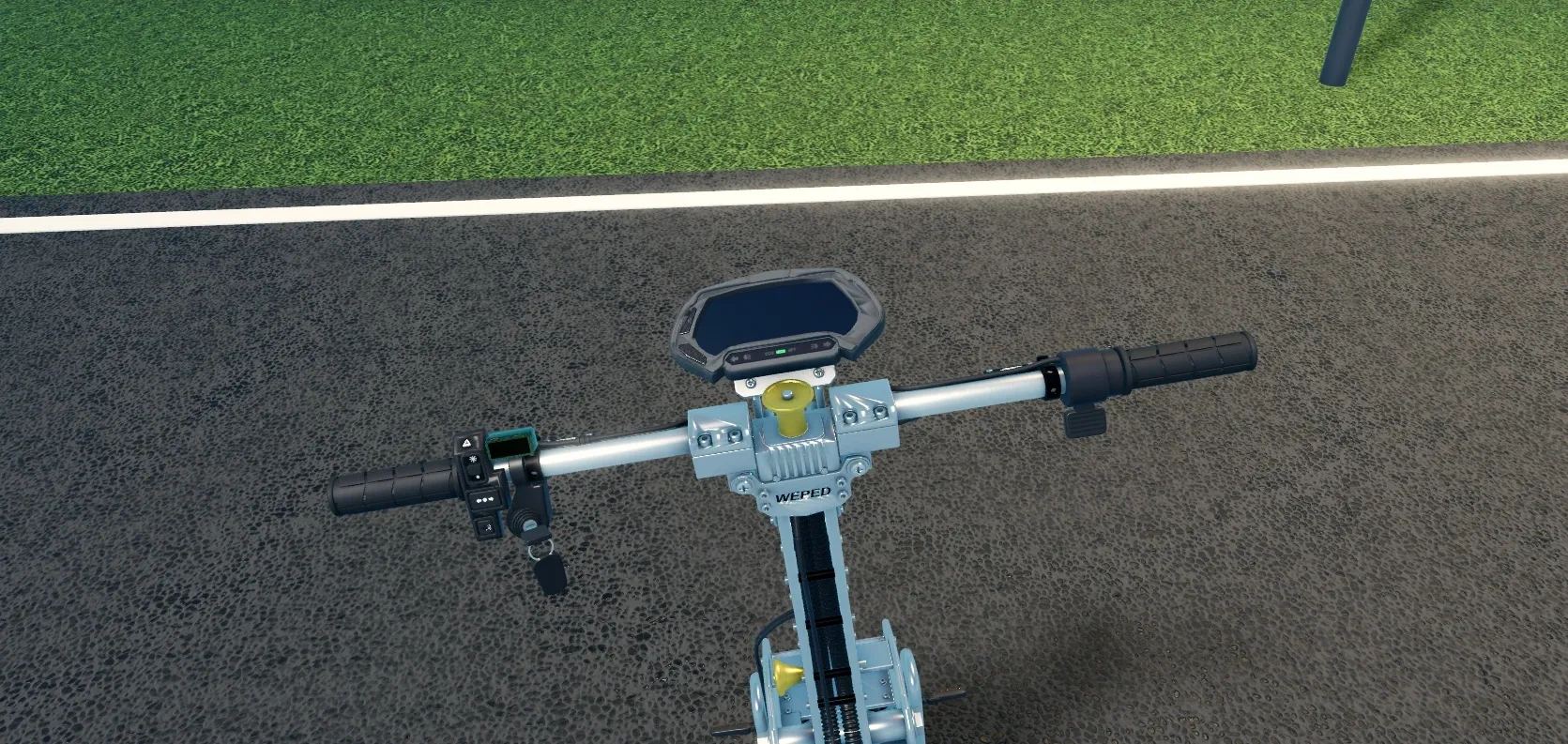
CT-22 LCD (144 × 54 mm face, recessed in an 8 mm deep funnel)
- Big yellow speed digits and the mode strip ECO / NRM / SPT
- Pack voltage — 66 to 84 V by state of charge
- Trip kilometres since switch-on and the ODO
- Clock with AM / PM (the game's time of day)
- READY while standing switched on, and an E–F battery gauge with 10 bars
- The live fields follow the maker's field list F01–F08
Buttons & controls
- Four-button multi switch and a key box with a green voltmeter that shows live voltage
- Modes ECO 45 / NRM 80 / SPT 120 km/h (130 with the unlock)
- SUPER LAUNCH (TUNE) — a burnout start that cuts 0–60 km/h from 3.8 to 3.3 s
- /sx rgb controls the RGB light strips
Full key list: Controls.
Lights
- Two round headlamps on the fork
- Tail lamp with 28 LED domes and a middle brake bar
- Four slim amber turn signals
- RGB strips along the stem edges, the deck side, the fork and swing-arm windows, under the deck and on the kickstand — waves, blinking and steady rainbow patterns
The 3D model
The Sonic X was the hardest model to build — almost every part is a CNC-cut aluminium plate and few reference photos exist. It was built in Blender over 12 sessions, with the camera of the key factory photo solved mathematically so parts could be measured through it, and with the WEPED lettering cut into the metal as on the real scooter.
- Game parts
- 450
- Triangles
- 561,638
- PBR texture maps
- 557
- Exported
- 15 November 2026
colour, normal, roughness, metal
from the export manifest
Geometry
- 450 game parts and 561,638 triangles in the export of 15 November 2026, with 557 baked maps on 144 textured parts; another 306 small parts use flat materials (screws, LED segments, plates).
- Hard dimensions from a tape measure in a ride video — exposed deck top 603 mm, deck plate 350 mm wide, handlebar 970 mm above the deck and 765 mm wide; tyre CST 125/60-7 (300 × 130 mm).
- Measured on the model — wheel radius 0.150 m, wheelbase 1.115 m, steering axis 12.0° (the head tube).
- The arch between neck and deck is a stack of four plates — two middle plates 12 mm apart and two low side plates at ±43 mm; plate edges are half-round, not flat chamfers.
- The display stands on two long side arms rooted on the stem plates, tilted 54° and recessed behind sloped walls, as measured through the solved camera.
Mechanics & moving parts
- One front oil coil-over (rigged as body, rod and spring) and two rear shocks; the front wheel slides along the head tube as the fork works.
- Swing arms, wheels, both flat black brake masters, the thumb throttle and the kickstand move.
- The rear suspension carries a bridge with two red adjuster knobs, springs, a cross bar and a T-block with two rods, rebuilt from a photo of the deck with its cover off.
Working components
- The voltmeter in the key box shows the live pack voltage, not a printed number.
- Every LED of the RGB strips is its own segment (about 17 mm long), so patterns can run along them.
- The CT-22 screen is live and shows only what the real one shows.
- The snail horn is a modelled 3D part with a drawn label.
Accuracy against the real scooter
- The factory photo's camera was solved from known points, then the bar axis was moved 30 mm back, the display tilt corrected from 35° to 54° and the display lowered 26 mm to match it.
- Widths come from the silver factory unit only; photos of tuned red, gold or chrome units were used for style, never for dimensions.
Known differences
- The 32° steering lock is not measured yet.
- Headlamp spacing (120 mm) is the measured middle of 114–126 mm across different photos.
Pictures
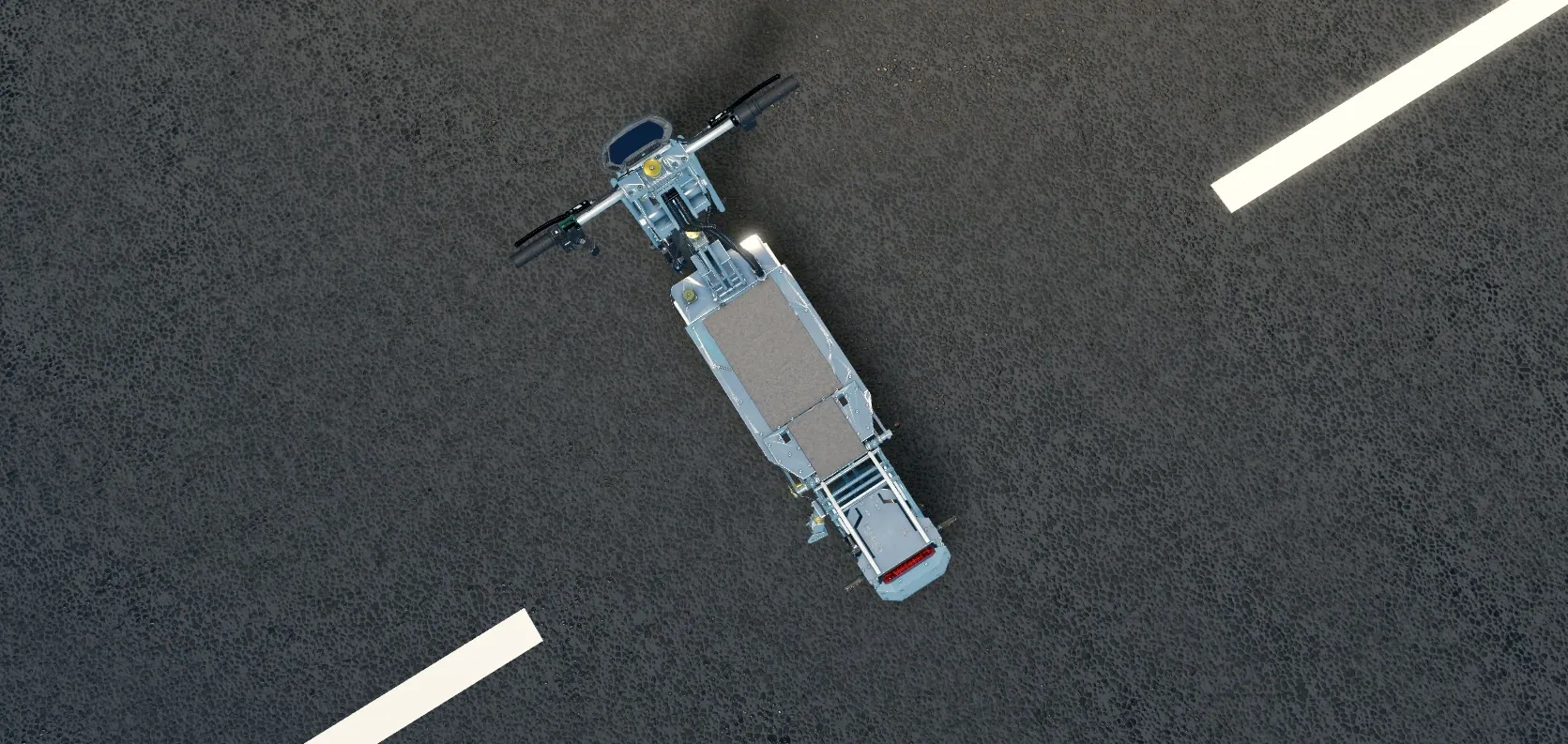
Renders of the game model and captures from the game. Select a picture to open it at full size.
Strengths in gameplay
- 120 km/h stock, 130 km/h with the $4,000 unlock, about 165 km/h with full tuning — the fastest in the game
- SUPER LAUNCH — 0–100 km/h in 6.6 s instead of 7.1 s
- 4,200 Wh and 13-inch tyres
- Two calipers on the front rotor
Trade-offs
- $32,000 — the most expensive scooter for in-game money
- 79.5 kg — the front lifts only at about 0.63 g, so a wheelie needs a half-jump
- Steering lock 32° is an estimate (not measured)
How to get the WEPED Sonic X
$32,000 in-game. Bought in the SHOP with money earned by riding. Also available at once with the WEPED SONIC X pass (299 R$).
The WEPED SONIC X pass (299 Robux): The WEPED Sonic X now, without the wheelie challenge, a SPEEDSTER tag and $10,000.
Customization
- RGB light patterns (/sx rgb)
Questions about the WEPED Sonic X
What is the fastest scooter in Scooter Hub?
The WEPED Sonic X. It reaches 120 km/h stock, 130 km/h with the $4,000 SONIC X 130 KM/H UNLOCK, and about 165 km/h with the RACE tuning package on the DYNO.
What is SUPER LAUNCH?
A launch mode only the Sonic X has (TUNE › LAUNCH). The rider holds the front brake, spins the rear tyre for about a second and releases — 0–60 km/h drops from 3.8 to 3.3 s and 0–100 km/h from 7.1 to 6.6 s, measured in the game.