Commuter
KuKirin G2 Master
The first upgrade — dual 1,000 W motors, 60 km/h and a dangling key for $3,000.
- Top speed in game
- 60km/h
- 0–50 km/h
- 6.65s
- Battery
- 1,082Wh
- Price
- $3,000
DYNO flat out 58.2 km/h
Stock, DYNO
52 V 20.8 Ah
In-game money

Overview
The KuKirin G2 Master is the first scooter most players buy. In Scooter Hub it is a light dual-motor scooter with three modes up to 60 km/h (55 km/h on one motor), a 52 V 1,082 Wh pack, 10-inch off-road tyres and hydraulic-damped coil-overs.
The KuKirin G2 Master is the step most players take after the free Ninebot. It is small and light, but it has two 1,000 W hub motors, a 52 V battery and front and rear coil-over shocks with hydraulic damping — real performance-scooter hardware in a commuter-sized frame.
In Scooter Hub it reaches 60 km/h in mode 3, matching the factory table; switch to a single motor and the top speed drops to 55 km/h, exactly as the manufacturer lists it. Its 140 mm cable discs are the smallest brakes of the dual-motor scooters, so it rewards braking early.
Its display is a faithful copy of the real hexagonal LCD: every segment was drawn at its measured position, and the P-settings work the way they do on the real scooter, with the setting number in the speed digits and its value in the odometer.
In Scooter Hub the KuKirin G2 Master has 3 riding modes (1: 20 · 2: 40 · 3: 60 km/h). It weighs 33.5 kg, carries a 52 V 20.8 Ah battery (1,082 Wh) and has two 1,000 W hub motors. It lifts into a wheelie on the throttle and the rider pulling back.
Real scooter vs in-game
What the manufacturer publishes next to the numbers the simulation actually uses. Tags show where each game number comes from: C manufacturer figure, M measured on the 3D model, E simulation estimate where no factory figure exists. How we source numbers.
| Specification | Real KuKirin G2 Master | In Scooter Hub |
|---|---|---|
| Top speed | 60 km/h with both motors (modes 20 / 40 / 60), 55 km/h on a single motor. | Modes 1: 20 · 2: 40 · 3: 60 km/h C (Manufacturer) DYNO flat out: 58.2 km/h |
| Motors | Two hub motors, 1,000 W rated and 1,200 W peak each. | 2 × 1,000 W rated C (Manufacturer) Simulated peak 1,200 W and 30 N·m per motor |
| Battery | 52 V 20.8 Ah (1,081.6 Wh); 58.8 V charger, 14 cells in series. | 52 V 20.8 Ah · 1,082 Wh C (Manufacturer) 14 cells in series in the voltage model |
| Weight | 33.5 kg; maximum load 120 kg; 1,260 × 595 × 1,315 mm. | 33.5 kg C (Manufacturer) Max load 120 kg; the rider adds 75 kg in the physics |
| Brakes | Mechanical (cable) 140 mm discs front and rear. | 140 mm discs C (Manufacturer) Both levers up to 5 m/s² on dry asphalt, 58 % on the front; rear alone 4.7 m/s² |
| Suspension | Coil-overs with hydraulic damping front and rear. | Front 55 mm travel, 2.4 Hz Rear 50 mm travel, 2.3 Hz Spring-damper per wheel with bump stops |
| Tyres | 10-inch pneumatic off-road tyres, 255 × 80. | 10" C (Manufacturer), radius 0.124 m M (Measured) |
| Display | Hexagonal segment LCD with POWER, SINGLE / DUAL and P-settings. | Segment LCD in the hexagonal display (88 × 48 mm window) |
| Geometry | — | Wheelbase 0.987 m M (Measured), steering axis 11.6° M (Measured), lock ±38° |
Performance in the game
Measured with the game's own DYNO model (the same physics the scooter rides with): flat dry asphalt, 75 kg rider, full battery, top mode, both motors. "Sustained" is the speed after five minutes at full throttle, when motor heat limits power. Range is at a steady 50 km/h (or the scooter's top speed if lower).
| Setup | Top | Sustained | 0–50 | 0–100 | Range |
|---|---|---|---|---|---|
| StockFactory scooter, no parts | 58.2 km/h | 58.2 km/h | 6.65 s | — | 33 km |
| STREET packageController, better cells, semi-slick tyres | 58.7 km/h | 58.7 km/h | 5.32 s | — | 55 km |
| RANGE packageLargest pack that fits + a bag battery | 58.3 km/h | 58.3 km/h | 6.5 s | — | 76 km |
| RACE packageVESC controller, race cells, speed-wound motor, slicks, lowered | 118 km/h | 78.4 km/hHOT | 4.59 s | 11.39 s | 59 km |
| OFF-ROAD packageOff-road tyres, torque-wound motor, lifted | 54.3 km/h | 54.3 km/h | 5.88 s | — | 31 km |
| RAIN packageRain tyres and wet-weather pads | 58.2 km/h | 58.2 km/h | 6.71 s | — | 33 km |
Riding modes
| Mode | Top speed | Torque | Power |
|---|---|---|---|
| 1Starts in this mode | 20 km/h | 45 % | 30 % |
| 2 | 40 km/h | 75 % | 65 % |
| 3 | 60 km/h (55 on one motor) | 100 % | 100 % |
Display
Segment LCD in the hexagonal display (88 × 48 mm window)
- Speed, voltage, gear (Mode 1–3) and five battery cells
- DUAL / SINGLE motor indicator
- ODO, turn arrows, lights, brake, cruise and start-mode symbols, lit only while active
- P-settings menu shown in the real way — the setting name in the speed digits (P01 … Pb) and its value in the ODO digits
- Kilometres or miles (P01)
Buttons & controls
- POWER button — short press changes mode 1–3
- SINGLE / DUAL motor switch (T)
- Ignition key on a ring that swings while riding
- Lights, turn signals, horn and cruise control
Full key list: Controls.
Lights
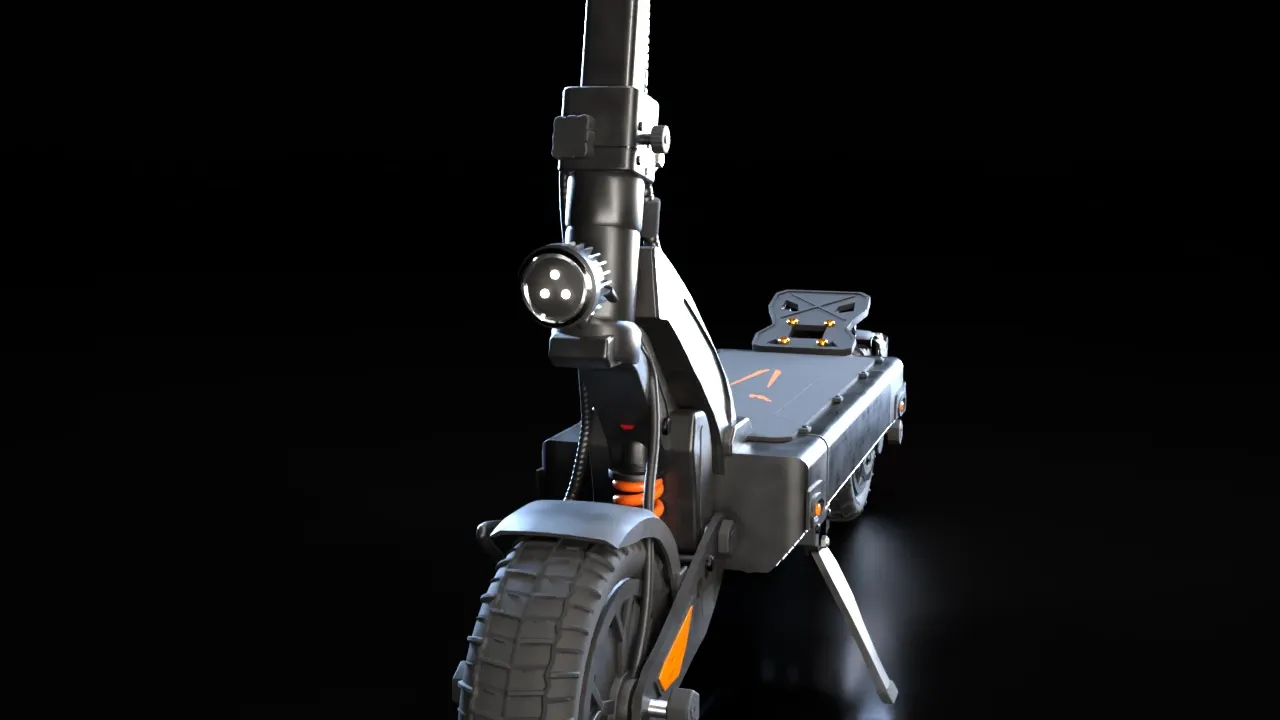
- White headlamp
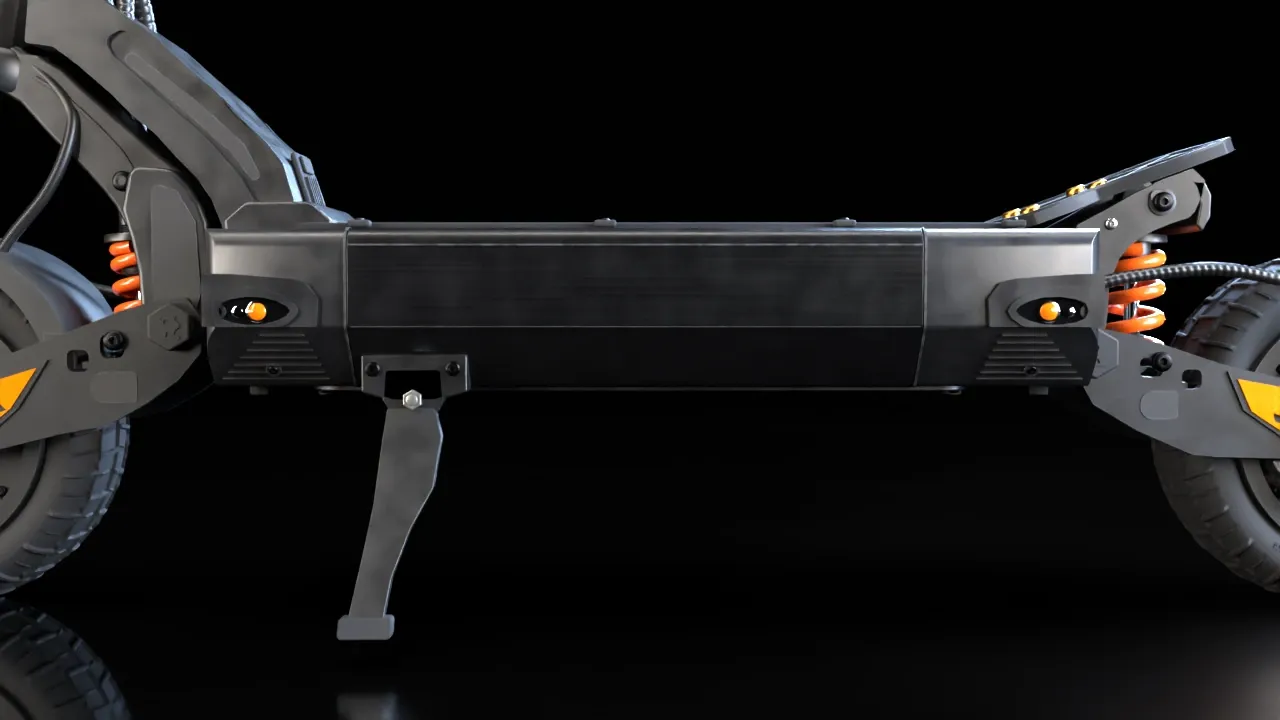
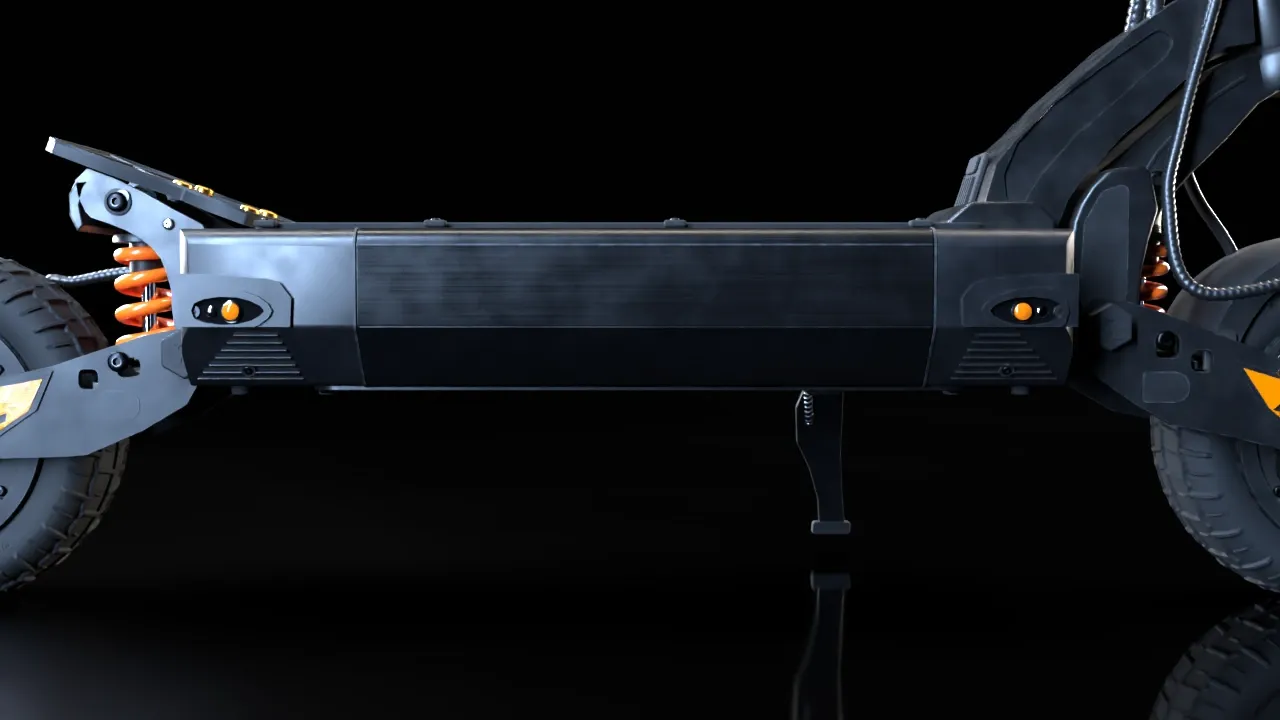
- Deep-orange corner lights on all four deck corners, blinking as turn signals and glowing as position lights
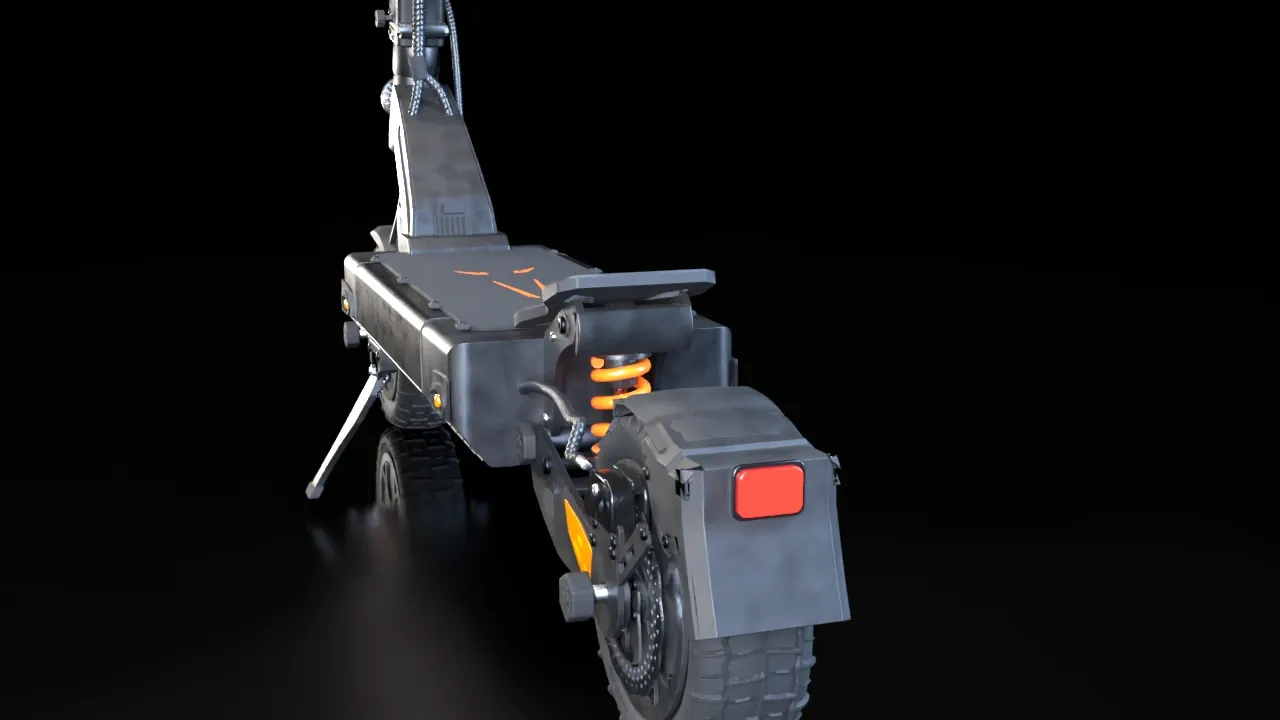
- Red tail and brake light on the rear mudguard
- Side logos backlit in deep blue (G)
The 3D model
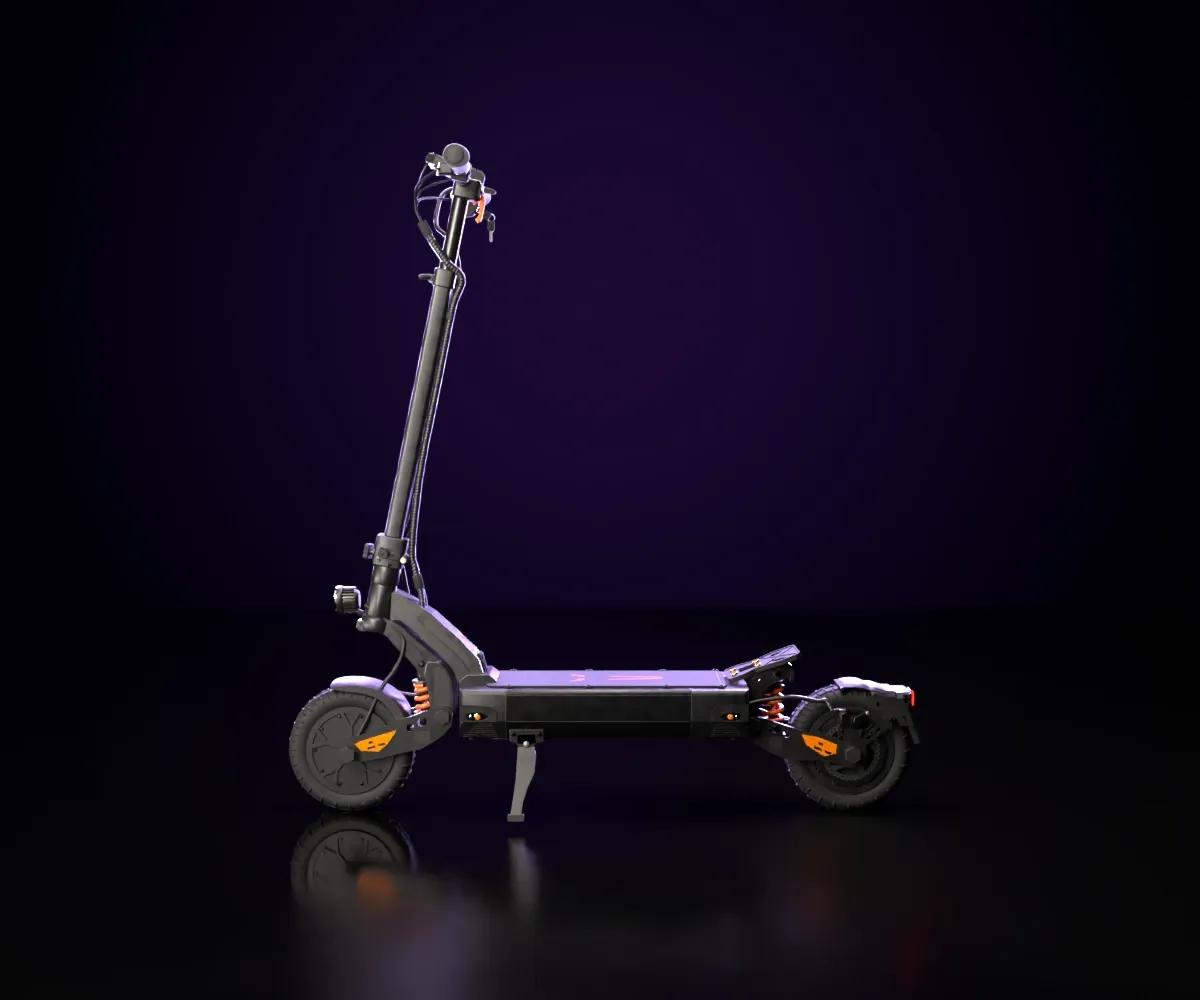
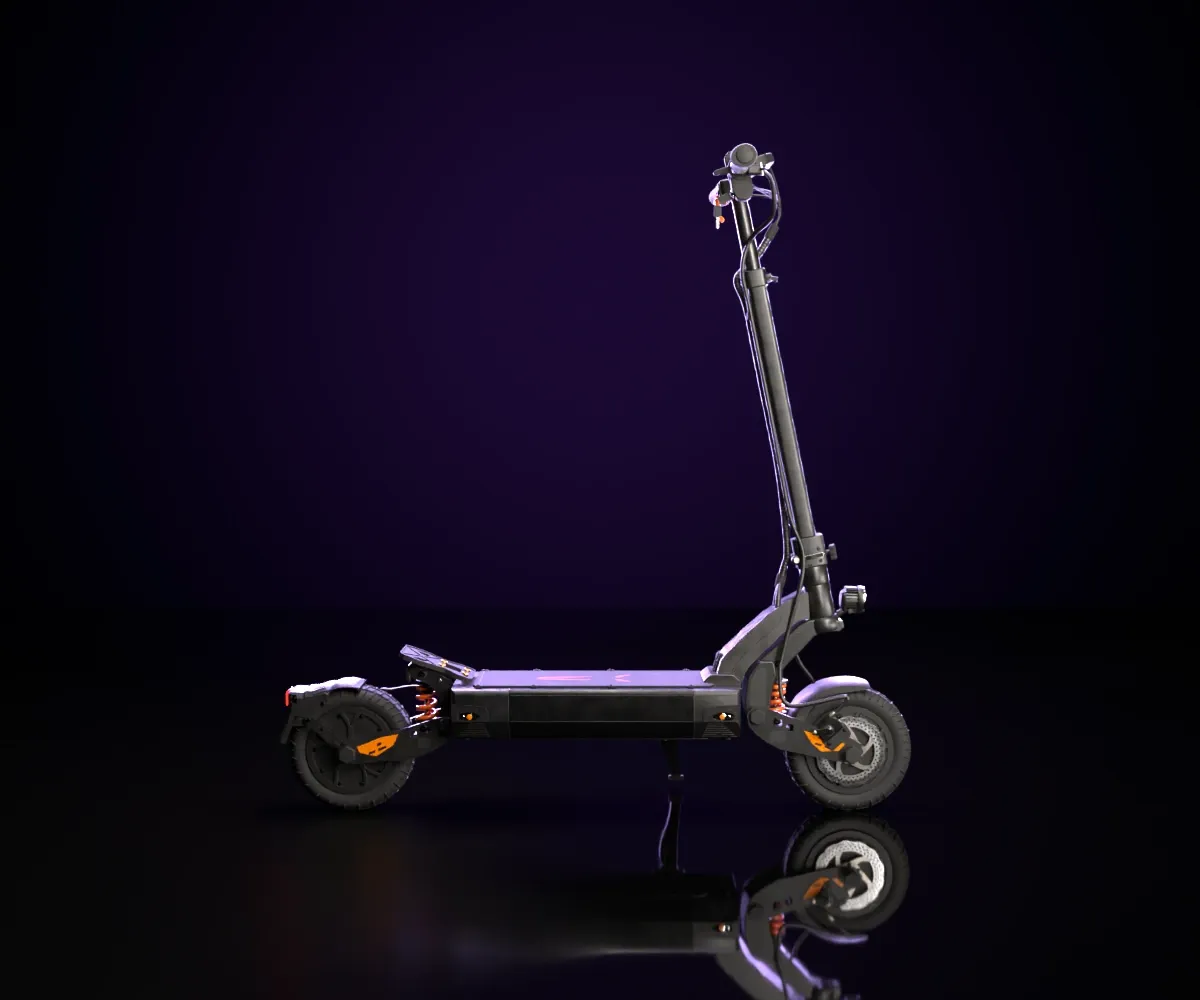
The G2 Master was modelled in Blender from the factory specification, the manual and the owner's photos (daylight and night), and exported as separate moving parts with their own baked textures.
- Game parts
- 50
- Triangles
- 346,908
- PBR texture maps
- 164
- Exported
- 24 October 2026
colour, normal, roughness, metal
from the export manifest
Geometry
- 50 game parts and 346,908 triangles in the export of 24 October 2026; 41 parts carry a 1024 px PBR set (164 maps).
- Measured on the approved model — wheel radius 0.124 m (255 × 80 tyre), wheelbase 0.987 m, steering axis 11.6°.
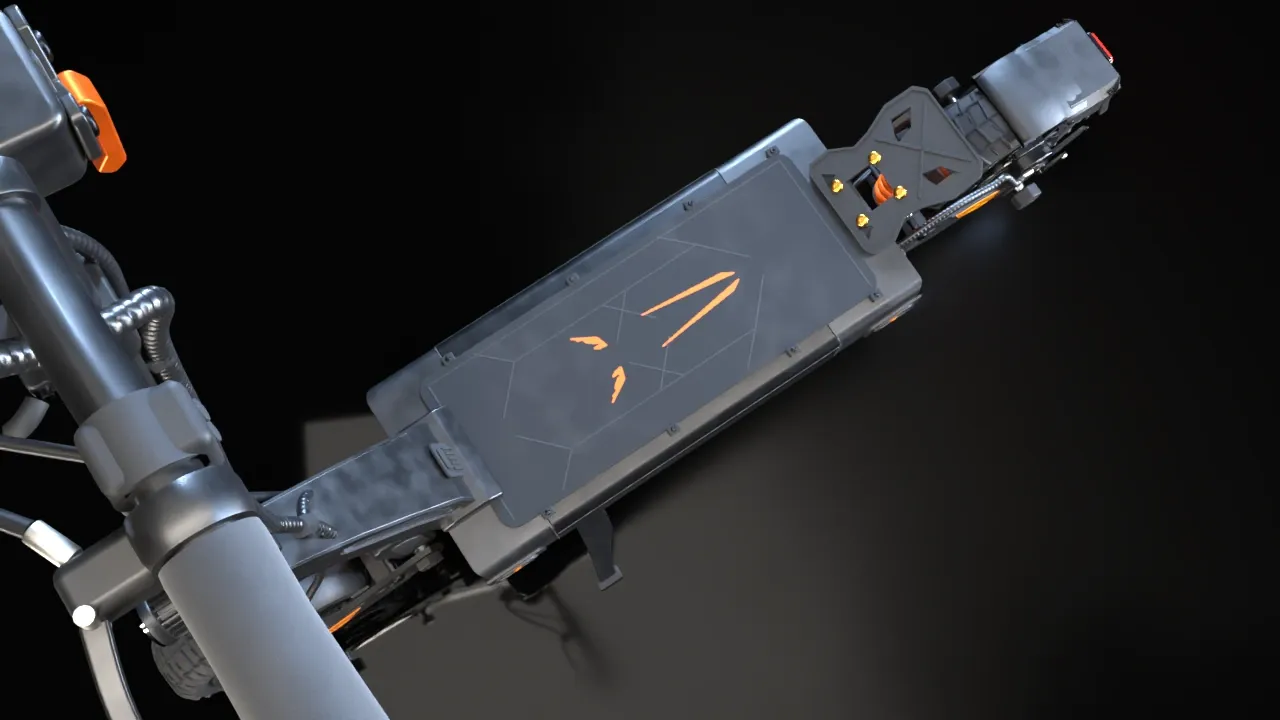
- The hexagonal display housing, the four deck-corner lamps and the deep-orange coil springs are modelled as separate parts.
Mechanics & moving parts
- Front and rear coil-overs are each rigged as upper body, lower body and spring, compressing along their own axis.
- Front and rear swing arms pivot on their real pivots; the wheels spin and the front turns with the fork.
- The rear mudguard carries the tail light, so a mudguard taken off (STRIP) or broken in a crash takes the light with it.
Working components
- Both brake levers and the thumb throttle move with input.
- The key hangs on a ring and swings like a real keychain while you ride.
- The kickstand folds out when parked.
- The LCD is a live segment display built from the real segment layout, not a static picture.
Accuracy against the real scooter
- The LCD segments were drawn one by one at their measured place and size from the owner's photos of every segment lit.
- Speeds and motor behaviour follow the factory table, including the lower 55 km/h top speed on a single motor.
Known differences
- Segments that no reference shows lit (the warning triangle, NON, the wrench) are used for game states marked as estimates in the game data; the wrench never lights because the game has no fault state.
Pictures
Renders of the game model and captures from the game. Select a picture to open it at full size.

Strengths in gameplay
- Cheapest dual-motor scooter — $3,000
- Light (33.5 kg), so it is quick to turn and easy to lift into a wheelie
- Off-road tread grips better on grass and dirt than road tyres
- Accepts the DUAL-CROWN and INVERTED fork upgrades (only the G2 Master and G4 Ultra do)
Trade-offs
- Smallest battery of the dual-motor scooters (1,082 Wh, about 33 km at 50 km/h on the DYNO)
- 140 mm cable discs — only a single-sided caliper upgrade fits
- 10-inch wheels feel every bump at 60 km/h
How to get the KuKirin G2 Master
$3,000 in-game. Bought in the SHOP with money earned by riding.
Customization
- Paint with finishes, factory graphics on or off
- Wraps, stickers and underglow
- Glass deck
- STRIP (take parts off)
Questions about the KuKirin G2 Master
Is the KuKirin G2 Master worth buying first in Scooter Hub?
For most players yes. It costs $3,000, more than doubles the Ninebot's speed (60 vs 25–35 km/h), and because money is paid per kilometre a faster scooter earns faster.
Why is the G2 Master slower on one motor?
Like the real scooter, its third mode is 60 km/h with both motors and 55 km/h with one. The SINGLE / DUAL switch (T) changes it.